Numerous paintings do not have a signature. One must then attribute them to an artist, assign them an authorship. If this is impossible, one speaks of an anonymous artist and specifies the age and school (eg: Flemish school, XVIth century). However, it is often possible to establish a bond with an artist. One time this band is fixed and then they say that the work is 'from' or 'by' Rubens. The other time this band is less certain. If a slight doubt persists, it is said that the work is 'attributed' to Rubens. If one judges that the work is not of the master, but of one of his pupils, one speaks of 'the workshop of' Rubens. If one thinks that the band is less strict, that is to say that the painting dates from the master's period and was inspired by him, but is not his or his studio, then one speaks of the 'entourage of' Rubens or from a follower of Rubens. Finally, when the work dates from a period after Rubens (and sometimes with a difference of several centuries), one speaks of a painting 'in the style of' or 'in the manner of', or 'to'.
Posts tonen met het label monogram. Alle posts tonen
Posts tonen met het label monogram. Alle posts tonen
dinsdag 17 juli 2018

dinsdag 5 mei 2015
Hoe een kunstschilder achterhalen?
Hoe kunt u het snelste een kunst schilder achterhalen van een schilderij? hierbij een aantal handige tips.Wanneer het signatuur redelijk leesbaar is maar niet helemaal, gebruik dan het gedeelte dat u wel goed kunt lezen. Hierbij een mooi voorbeeld. Dit was een schilderij dat ik laatst nog had opgezocht.

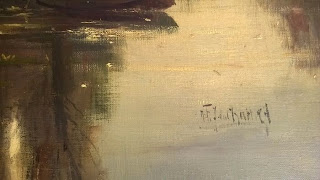

Het signatuur is redelijk onleesbaar. Er zijn wel een aantal letters die wel goed zijn te lezen. zoals de F & Chatt. Dit zijn dan ook de letters waarmee ik ga zoeken. Om te beginnen zoek ik bij een lijst met Nederlandse kunst schilders omdat dit nauw eenmaal een schilderij is dat is gekocht in Nederland.
Er zijn verschillende site's waar dit te vinden is maar voor het gemak heb ik een lijst met Hollandse schilders op deze blog geplaatst ->.
 Er verschijnt nu een zoek venster, hierin typt u uw duidelijk leesbare letters uit het signatuur.LET OP! de leesbare letters dienen wel naast elkaar te staan in het signatuur. Bij het voorbeeld was dit "chatt" Er zullen een aantal namen gevonden worden. Vergelijk deze namen met het signatuur en mogelijk vind u de juiste. Bij het voorbeeld van de schilder kwam duidelijk naar voren het gedeelte "chatt" en het zoek resultaat had dan ook direct een match met de juiste schilder.


Het signatuur is redelijk onleesbaar. Er zijn wel een aantal letters die wel goed zijn te lezen. zoals de F & Chatt. Dit zijn dan ook de letters waarmee ik ga zoeken. Om te beginnen zoek ik bij een lijst met Nederlandse kunst schilders omdat dit nauw eenmaal een schilderij is dat is gekocht in Nederland.
Er zijn verschillende site's waar dit te vinden is maar voor het gemak heb ik een lijst met Hollandse schilders op deze blog geplaatst ->.
Klikhier: als er niks in de lijst voor komt
Click here: LIST ALPHABET DUTCH PAINTERS
klikhier: LIJST MET OUDE MEESTERS UIT HOLLAND (15de, 16de en 17de eeuw)
Zodra u op de site bent zoekt u snel en gemakkelijk door middel van de zoek optie.
CTRL + SHIFT + F


Rossum du Chattel van Frederic Jacobus 1856-1917
Nu kunt u gemakkelijk met behulp van google achter halen wie de schilder is dat match. Op internet is tegenwoordig veel te vinden zo ook wat voorn schilder het is. Of het schilderij dat u heeft, overeenkomt met de werkend van de gevonden schilder. En natuurlijk of het signatuur overeenkomt met de gevonden schilder. Zo is al snel te vinden dat de schilder vaak zijn handtekening zet met "Fred.F.du Chattel".
Het schilderij dat ik opzocht was echter anders. "n.F.J.du Chattel". Veel schilderijen zijn vaak na geschilderd van grote meesters. De schilderijen werden dan vaak gesigneerd met een letter N ervoor dit wil zeggen geschilderd Naar. Door google af te zoeken met de schilder is er veel te vinden. Zo ook het originele werk van van du chattel.
Het na gemaakte werk van du chattel:

De Utrechtse Vecht en haar omgeving inspireerden F.J. van Rossum du
Chattel tot het schilderen van talloze impressies van deze rivier, reden
waarom hij door critici ‘de schilder van de Vecht' werd genoemd. Ook
schilderde hij het landschap rond Den Haag. Hij werd in 1856 geboren in
Leiden, kreeg zijn eerste schilderlessen van zijn vader, Jan Hendrik van
Rossum du Chattel, en werkte daarna in Den Haag op het atelier van de
Haagse impressionist Willem Maris. Musea: o.a. Het Haags Gemeentemuseum.
Heeft uw schilderij geen signature kijk dan hier: Hoe kunst schilder achterhalen zonder signature / handtekening achterhalen ?
Abonneren op:
Posts (Atom)